In accordance with my lessons learned from last year, I planned to operate as a rover. My original plan was to be QRV on 6 bands: 50, 144, 222, 432, 902, and 2304 MHz.
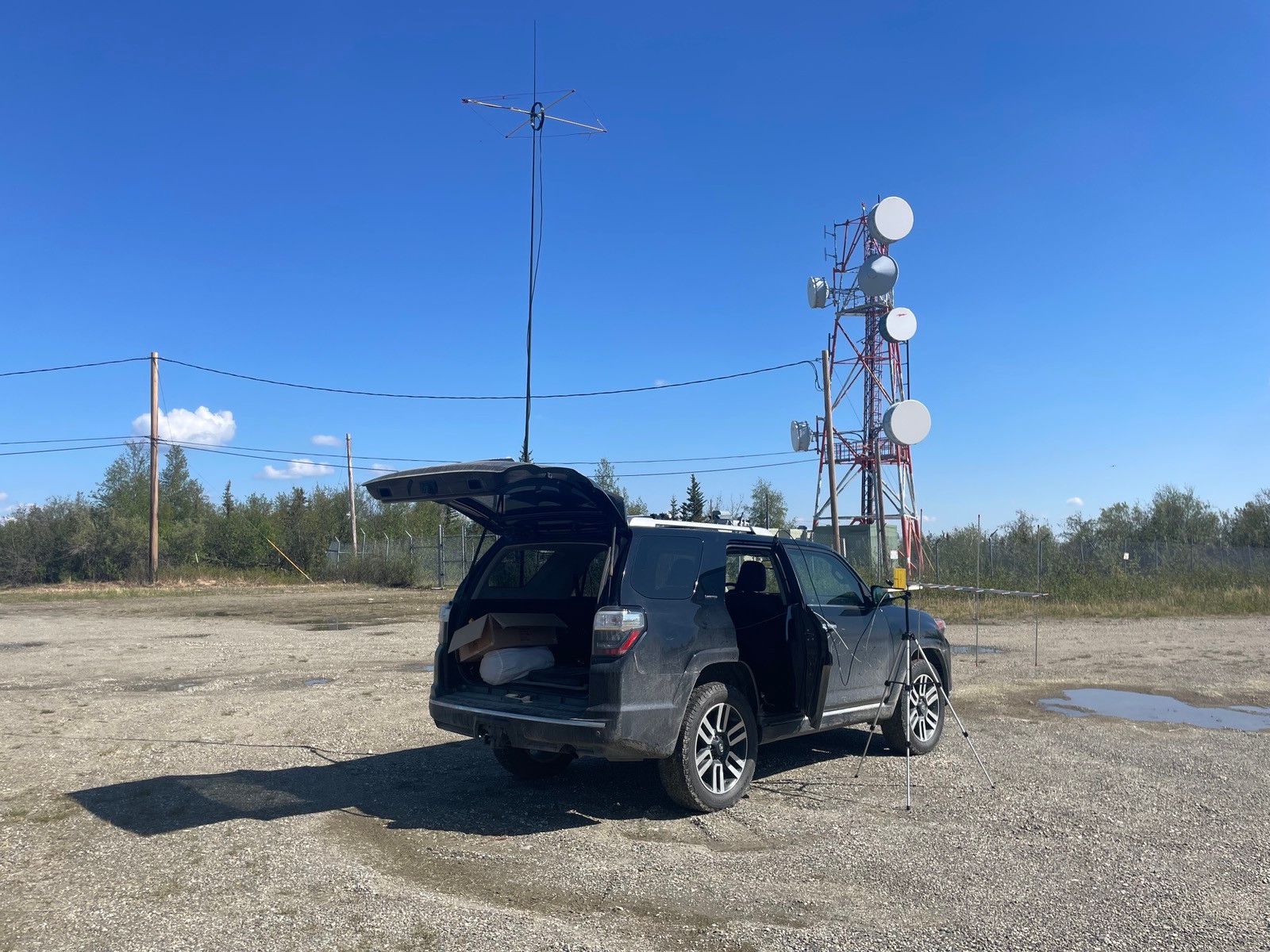
Roving was a riot: beautiful weather, few bugs, lots of time driving around the Fairbanks area to move between operating locations. I ended up operating at four locations during the contest: the summit of Pedro Dome in BP65, near the Chena Ridge VOR site in BP54 overlooking the airport, the parking lot of my apartment complex in BP64, and (on recommendation by KL4TQ; many thanks!) a hillside off Spinach Creek road in BP54 near SOTA KLF/FN-200.
The Chena Ridge site had pretty bad RFI including from very close powerlines, so I’m thankful to find the Spinach Creek site for future roving and grid-expeditions.
Per band review
50 MHz
Same omnidirectional halo as last year, rebuilt and cleaned up considerably. I considerably improved the method for deploying the mast. Last year involved tying the SOTABeams mast to the car door handle. This year I have a piece of PVC bolted to some clips on the roof rails. It has a tee at the end that I extend the mast through. The antenna is right at the limit of what the mast will support, so I likely need to start looking into a better option. The air-core choke doesn’t quite seem to tame the common mode, as I had problems keeping the soundcard interface connected. Perhaps it needs to be moved a bit further down the mast. I had significant problems with 6m FT8. The serial CAT cable I ordered was the wrong gender, so I used VOX keying and I think there was some problem with the switching back and forth. I had my clock synced over NTP, and sometimes I could decode, but not decode others, and sometimes the opposite, even with clean, strong signals in both directions. A very strange problem. I’m happy I was able to work one JA station during an opening, but there were plenty of other stations that I could see but not decode. I wish I had moved to CW or sideband to take better advantage of the opening. This was my first real experience with the “magic” of 6m: amazing to watch a dead band explode into activity in seconds, fade up and down for a minute or two, and disappear back to nothing.
144 MHz
Yaesu mobile (many thanks to KL1JP) and Arrow satellite yagi. I put together a hinge that mounts on my tripod to allow quickly twisting the antenna to set either the 2m or 70cm yagi to be vertically polarized. This turned out to be slick, and better than nothing, but rather annoying in practice. I would often forget to return the antenna to set 2m to vertical after working someone on 70cm, and boy howdy that’s a lot of cross-pol attenuation.
222 MHz
I brought the FM handheld, but there just isn’t anyone with equipment for the band. Maybe I can talk some locals into getting handhelds as well to at least have some people on FM. A couple local repeaters are in the process of being connected via a 222 auxillary link, so perhaps that could stir some interest.
432 MHz
Handheld and the arrow yagi. Until just a handful of years ago, the primary user of the band up here was a long range missile warning radar out at Clear AFS, so there are still quite a few people up here who are only set up well for 2m and lower.
902 MHz
Meshtastic with a PCB yagi from WA5VJB. Hop count set to 1 to only allow direct QSOs, no digipeating. My CQs got automatic acknowledgements, but I didn’t make any skeds with anyone or do any testing beforehand to test the process of making QSOs. I plan to try again in September.
2304 MHz
Antenna was built in time (article to come), but the SDR and software setup wasn’t all ready, nor was my planned sked’s software ready. We plan to do some tests in the coming weeks and retry in September.
Lessons learned:
-
Check and double check when buying things: cable gender and shipping destination. I don’t know if anyone is QRV here for 2m sideband/cw, but I had a 2m amp ordered but shipped it to my parents’ place.
-
Run a dress rehearsal to make sure the radio works right, and to test QSOs with some people you plan to work during the contest. A weekly multiband simplex net might be a good idea.